
Livingston Projected and Actual Dates
A projected date is a calculation based on the sentence and information currently in the custody system. It is not a completed event. An actual release date records that the person left confinement. Even then, the destination matters. Release from IDOC to mandatory supervised release means the person left prison confinement but remains under correctional supervision.
IDOC uses two distinct public-profile labels. PROJ MSR DATE is the expected transition from confinement into mandatory supervised release under the current calculation. PROJ DISC DATE concerns the projected endpoint of the correctional sentence and supervision. They must not be treated as synonyms.
A Livingston County Jail pretrial detainee has no computed IDOC release date. Court action and any remaining hold govern departure. A county sentence also must be read from the sentencing order, credit for time served, and the Sheriff's actual discharge entry.
Find a Livingston Projected Release Date
First identify the last custodian. Livingston County Jail, Pontiac Correctional Center, and a federal detention placement use different records.
- For an Illinois prison sentence, open the IDOC Individual in Custody Search.
- Search by IDOC number when known, or use name or birth date and compare identity data.
- Open the profile and read current location or status, admission and release data, PROJ MSR DATE, and PROJ DISC DATE as separate facts.
- For county custody, call Livingston County Jail at 815-844-5774 and review the sentencing order through the Circuit Clerk or Judici.
- If an exact event record is needed, request it from the Sheriff or IDOC rather than calculating it independently.
The Livingston County search guide helps determine whether county, state, federal, or immigration custody is the right branch.
The successful manifest capture below comes from the IDOC FAQ, which explains public information and sentence-credit effects.
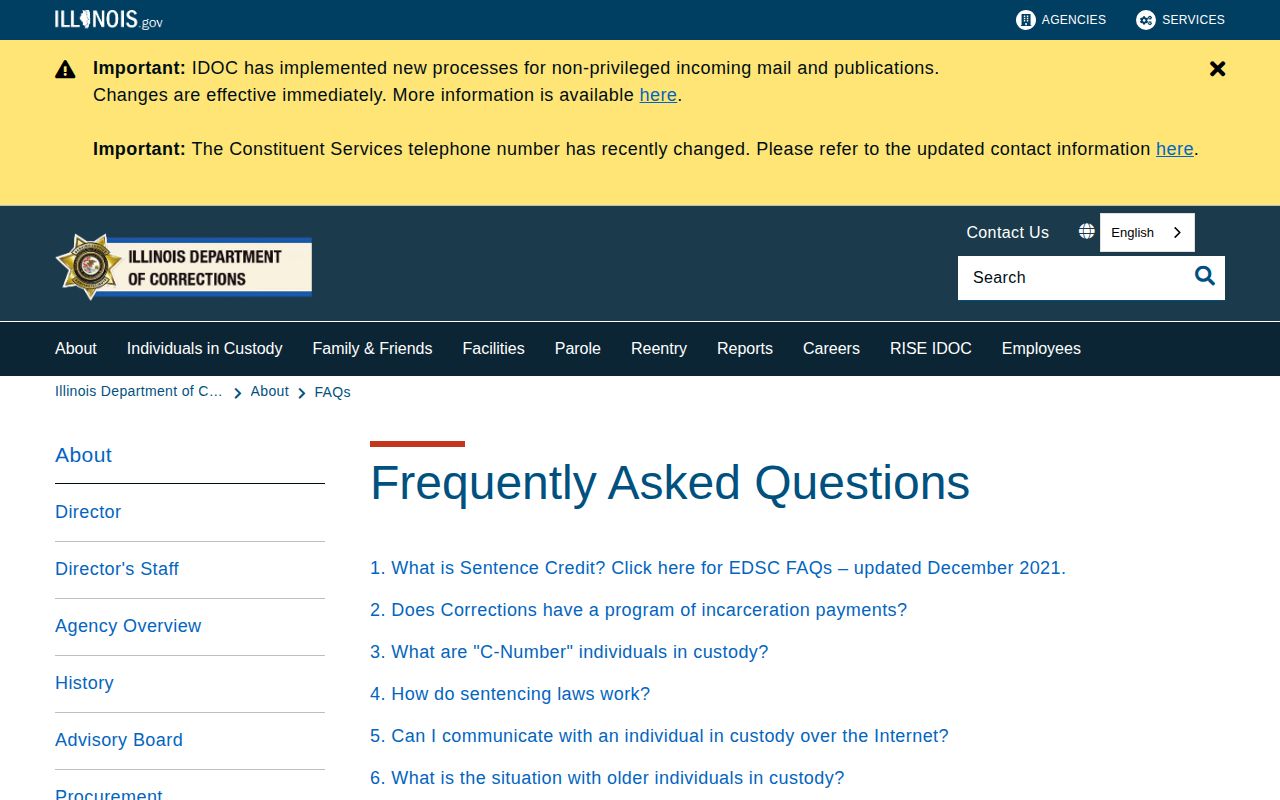
The state explanation supports reading a profile date as a live calculation that may be revised, not as a promise of release.
Illinois Credits in Livingston Date Lookups
Illinois sentence credit is governed chiefly by 730 ILCS 5/3-6-3, but the percentage and credit eligibility depend on the offense, offense date, and sentence. Illinois structures include 50, 75, 85, and 100 percent service rules. A broad claim that every person “gets half time” or always serves 85 percent is wrong.
IDOC describes statutory, program, and earned sentence credits. Program credit is generally one-half day for each successfully completed program day when the person and sentence qualify. People serving 85 or 100 percent are not eligible for program credit. Earned Sentence Credit can reach up to 180 days at the Director or designee's discretion for an eligible person who has served more than 60 days and meets other requirements. It is not automatic and may be lost.
Statutory credit and discretionary credit are not the same. A statutory structure applies only as the governing law permits, while an earned discretionary award depends on eligibility and an agency decision. Program participation can affect an eligible calculation, but it does not erase offense-based limits. Credit may also be revoked through disciplinary process.
An award that revises the release date appears on the public profile. Disciplinary loss, restoration or revocation of credit, and new sentence information can revise it again. The IDOC sentence-calculation directive explains that determinate sentences are calculated toward projected and mandatory dates.
A mittimus is the court's written commitment order. New or corrected mittimus information can change the term, credit already earned in jail, or whether sentences run at the same time or one after another. IDOC then recalculates from the legal record. An older profile capture should not be treated as a current promise.
Note: No verified Livingston-specific county good-time or weekend-release policy was found, so use the order and actual jail record.
Why Livingston Release Dates Change
IDOC recalculates when the legal or custody inputs change. County departures can also be delayed by an order-processing step or another authority's hold.
| Factor | Possible effect |
|---|---|
| Sentence-credit award | May move an eligible projected date earlier. |
| Disciplinary credit loss | May move the date later under authorized process. |
| New mittimus or sentence data | Can change concurrent, consecutive, jail-credit, or term calculations. |
| Appeal bond, escape, or loss of time | Can require additional calculation changes. |
| MSR violation | Return to custody can lead IDOC to recalculate. |
| Other-agency detainer | Departure from one custodian may become a transfer instead of community release. |
| Court order | Can change the legal basis or timing of a county custody event. |
Old-law indeterminate parole differs from modern determinate MSR. PRB may grant or deny parole in qualifying C-number cases, while most modern prisoners reach MSR through the sentence calculation. Youthful parole under 730 ILCS 5/5-4.5-115 is another limited statutory path and should not be generalized.
Confirm Livingston's Actual Release
On or after the projected date, reopen the IDOC profile and compare current status with actual admission and release data. If the profile has not changed, contact IDOC at its public number, 217-558-2200, or submit a focused FOIA request. Ask for the existing record of actual release date, release status or type, institution released from, and relevant admission or discharge information.
For the county jail, compare the court order with the Sheriff's discharge or transfer entry. Judici can show a disposition, sentence, hearing date, or minutes but may not state the jail-door time. The Sheriff's record proves the physical Livingston County custody event.
Register through the Livingston County VINE inmate check before the expected event when available. VINE may report release or transfer, but an exact timestamp still belongs with the source record.
Livingston Jail Dates Versus IDOC Dates
County and state dates cannot be merged. A Livingston County Jail discharge date is departure from county custody. If IDOC admission follows, the person was transferred into state custody. Later, an IDOC release can mark departure from prison into MSR, old-law parole, or another status. Final discharge may occur later still.
Pontiac's local geography can hide that system change. The county jail and Pontiac Correctional Center are both in Pontiac, so a person may stay in the same city while moving into a new custodian. Follow the agency, not the place name.
When a Livingston Date Passes
A projected date that passes without a status change is a reason to verify, not to speculate. Credits can change, an MSR violation can intervene, a detainer can redirect the person, or the public profile may await a source update. Recheck the current status and ask the custodian for the actual record.
Likewise, a “Released” result in BOP means no longer in BOP custody, not freedom from all authorities. ICE, a state system, or supervision may still apply. The same narrow-reading rule protects accuracy across every Livingston release-date lookup.
Read Livingston IDOC Date Fields
An IDOC profile can include the person's name, IDOC number, photograph, parent institution, current location or status, vital statistics, admission and release data, holding offense, sentencing information, and projected dates. Start with the identifier and present status. Then read the admission and release area before looking at a future date. This order reduces the risk of treating an old projection as current custody information.
“Parole” or “MSR” means release from confinement into supervision, not final discharge. Another institution name means transfer. If the profile is unclear, use IDOC's public phone or FOIA. Do not call the separate number labeled for government and law-enforcement use as if it were the public help line.
Livingston County Sentence Records
Do not apply IDOC's public profile fields to a county-jail sentence. Obtain the Livingston sentencing order from the Circuit Clerk, review credit for time served and the sentence structure, and ask the Sheriff for the actual discharge entry. The court order and jail record answer related but different questions.
No verified Livingston-specific weekend release or county good-time policy appeared in the research. That absence rules out a shortcut calculation. It does not mean no lawful county credit exists in a given case. It means the correct answer must come from the governing order, authorized local calculation, and actual custodian record.
A pretrial detainee is different again. Without a sentence, there is no projected sentence-completion date. A pretrial release order, dismissal, other court action, or hold can change custody. Ask about the present event rather than calculating from an arrest date.
Livingston MSR and Final Discharge
Most modern Illinois determinate prisoners move to mandatory supervised release at the calculated point. The Illinois Prisoner Review Board establishes conditions and handles violation proceedings, while the IDOC Parole Division supervises parole and MSR. An alleged violation can lead to return to release with conditions or revocation and return to custody, after which IDOC recalculates.
Old-law parole applies to limited indeterminate cases, and youthful parole is a separate statutory route. A parole grant releases the person subject to conditions. It does not erase the remaining sentence. PRB may also grant early final discharge in an eligible supervision case. Thus confinement release, supervision start, and final discharge can be three distinct Livingston date questions.
Livingston Supervision Date Proof
For an old-law C-number case, IDOC computes eligibility before the institutional interview and full-Board process. A denial can set a later review, while a grant begins conditional parole. That path differs from the projected MSR calculation used for most modern determinate sentences.
A revocation result can return a person to release with conditions or return the person to custody. If custody resumes, IDOC may calculate a new date. An earlier actual release date stays in the history, but it does not establish present liberty or the next release date.
Projected discharge also needs a later check. Read current status and actual history after the date passes. If the profile is unclear, ask IDOC or PRB for the existing record that documents final discharge or current supervision.
County probation follows another line. It ends through the Livingston court process, not through an IDOC projected discharge field. Use the court order and Circuit Clerk record to establish termination, extension, or another probation action.
Request Livingston Date Records
A focused IDOC request can name the actual release date, release status or type, institution released from, admission and release history, projected MSR information, and projected or final discharge information. IDOC's FAQ warns that other master-record material can remain confidential unless disclosure is authorized. Asking for existing named fields gives the records office a clear scope.
For Livingston County Jail, request the sentencing order from the Circuit Clerk and the actual discharge or transfer entry from the Sheriff. Those records answer different questions. The order supplies the legal sentence and credit framework, while the jail entry records the physical event. If another agency took custody, the receiving system must supply the next release date.