
Livingston Supervision Discharge Records
Release and discharge are not synonyms. Release from Pontiac may start MSR, while discharge marks the sentence's end. Read current status, actual release data, projected MSR, and projected discharge as separate facts. For proof, call IDOC at 217-558-2200 or request the existing record through IDOC FOIA. Court probation ends through a court order, not silence in a search.
Illinois VINE may send a release or transfer notice, but it does not decide supervision status or certify discharge. Confirm each alert with IDOC, PRB, or the Livingston court.
A projected discharge date is not proof that supervision ended. Recheck current status after that date and request the existing discharge record when exact proof matters.
Livingston Release Supervision Types
Illinois terminology matters. Most people sentenced under the modern determinate system leave IDOC confinement on mandatory supervised release, commonly shortened to MSR. It is a set period of community supervision tied to the prison sentence. It is not a discretionary finding that the person deserves traditional parole. IDOC's Parole Division supervises both MSR and parole, while the Illinois Prisoner Review Board sets release conditions and handles violation proceedings within its authority.
Probation comes from a court. A Livingston County judge may impose probation instead of, or as part of a lawful sentence. Livingston County Probation and Court Services administers local court supervision. The county docket and Circuit Clerk establish the order. An ordinary county-jail release does not automatically place someone on probation, and an IDOC release does not turn an existing prison sentence into court probation.
| Status | Source | Public verification path |
|---|---|---|
| Mandatory supervised release | IDOC sentence | IDOC status and release data |
| Old-law parole | PRB decision | IDOC profile, PRB record |
| Probation | Circuit Court order | Judici docket, Circuit Clerk |
| Pretrial release | Pretrial court order | Court docket and jail event record |
Verify Livingston Release Supervision
Start with the custody system, not the label used by friends or an old web post. The IDOC Individual in Custody Search can contain public information about current and former IDOC individuals. It commonly provides the IDOC number, parent institution, current location or status, admission and release information, and sentence data. A profile status of parole or MSR means the person left confinement under supervision. It does not mean final discharge.
- Search by IDOC number when known. Otherwise use the name or birth-date option and compare identity details.
- Open the matching profile and read current location or status separately from projected dates.
- For probation, search the Livingston County Judici docket and locate the sentencing or supervision order.
- Ask the Circuit Clerk for the official court record when the online docket is unclear.
- Use an agency records request for an existing PRB decision or IDOC release record when exact proof is needed.
A person can also leave Livingston County Jail by transfer to Pontiac Correctional Center. Both facilities are in Pontiac, but the move is into state custody, not post-release supervision. The full county-jail and state-prison search sequence appears in the Livingston County released-inmate lookup.
Livingston Probation Record Sources
The Livingston Circuit Clerk is custodian of the official court file. Judici is the county-endorsed public access route, but it is a third-party interface and uses a CAPTCHA. Read the case history, disposition, sentence, hearing dates, and minutes. A probation order may state the term and later court action. It may not reveal every operational detail held by Court Services.
Livingston County Probation and Court Services is the local point for court-supervision questions. No public name-based county probationer lookup was found. Disclosure limits may prevent staff from confirming every detail by phone, so pair the office contact with the court order.
Law and Justice Center
110 North Main Street
Pontiac, IL 61764
Phone: 815-844-5177
Fax: 815-842-1600
The Livingston County Circuit Clerk can supply the official record at the same Law and Justice Center. Its public phone is 815-844-2602, and office hours are Monday through Friday, 8:00 a.m. to 4:30 p.m.
Livingston MSR and Parole Records
Traditional parole mainly concerns old-law indeterminate cases, often called C-number cases. After an institutional interview and eligibility calculation, the full PRB may grant or deny parole. A grant begins supervised release for the sentence duration unless final discharge later occurs. A denial may set another review. Modern determinate cases usually follow the MSR path instead.
The old-law eligibility framework appears in 730 ILCS 5/3-3-3. IDOC first computes eligibility, then an institutional interview can precede full-Board consideration. Interview cycles may recur every one to five years. A denial can place the next review two to five years later. A grant is not final discharge. It starts parole for the remaining sentence unless the Board later records an earlier final discharge.
Youthful parole is a separate route under 730 ILCS 5/5-4.5-115. It covers qualifying people who were under 21 at the offense and whose sentences meet the statute's date and eligibility rules. It must not be used to describe all modern Illinois prison releases. Most determinate releases still lead to MSR based on sentence calculation and authorized credit.
The PRB publishes operations and hearing information, monthly institutional material, and en banc schedules. These are not a complete name-searchable archive of every grant and denial. Institution dockets may be arranged by month, while en banc pages provide full-Board dates, agendas, and registration details. An agenda or interview list shows a stage in the process, not the final outcome for every person.
PRB's clearest public results source concerns revocation. The posted monthly revocation results may show no violation, a return to release with conditions, or revocation and return to custody. Appeal outcomes may include a new hearing, denial, or reversal. These sources are not a universal parole-decision database. For an individual decision, identify the person and proceeding, then ask PRB Operations for the existing record.
The successful manifest image comes from the official PRB source and shows the agency channel used for Illinois supervision proceedings.
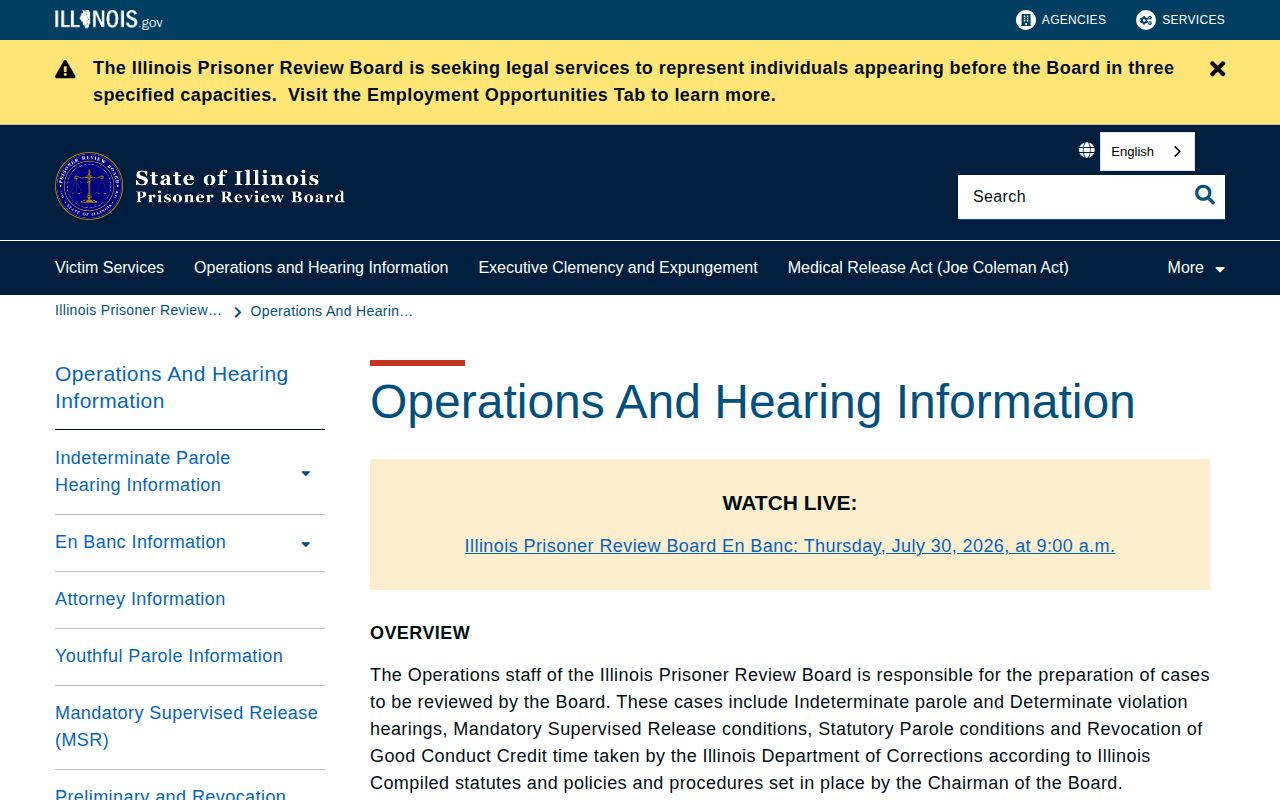
The screen helps identify the right Board process, while the IDOC profile remains the practical first check for a named person's current status.
Livingston Supervision Violations
Conditions govern conduct during MSR or parole. The PRB decides alleged violations in its jurisdiction. A finding can return someone to release with conditions or revoke release and return the person to custody. IDOC may then recalculate a date. That is why an old release date alone cannot prove that someone remains in the community.
Probation violations proceed through the court. The docket may show a petition, hearing, order, or warrant event. A missed appointment does not by itself prove an active warrant. Likewise, an arrest or transfer notice does not establish a final violation outcome. Confirm the court or Board record before drawing a conclusion.
- MSR
- Mandatory community supervision that follows confinement for many determinate Illinois sentences.
- Parole
- Conditional release under Board authority, chiefly relevant to old-law indeterminate cases and specific statutes.
- Probation
- A court-ordered sentence supervised through the judicial system.
- Revocation
- A formal decision that ends community release and returns the person to custody.
- Discharge
- The end of the correctional sentence or supervision, not merely release from a prison building.
Are Livingston Warrants Current?
The Livingston County Sheriff's navigation includes a Wanted Persons area. It is not a full parole-absconder search and does not preserve a reliable release archive. A web item may also be old. Current warrant status must come from the issuing court or law-enforcement authority.
PRB revocation schedules and results cover a narrower process. They can document a scheduled hearing or final revocation result, but they do not list every warrant or every person alleged to have violated supervision. Never infer present custody or absconder status from an undated item, an absence from a list, or a past missed hearing.
For an official Board record, contact PRB Operations at 217-782-7273 or PRB.OPERATIONS@ILLINOIS.GOV. A focused request should identify the person and ask for the existing decision or proceeding record rather than a new summary.
Note: A warrant, revocation case, and return to custody are separate events that require separate source confirmation.
Why Livingston Systems Differ
Livingston County contains a county jail and a major IDOC prison in the same city. This geography makes source selection unusually important. Someone may leave the jail and enter Pontiac Correctional Center without leaving Pontiac. The county will say the person is no longer held locally, yet the person remains confined by IDOC.
For an IDOC person, use the state profile. For a probation sentence, use the Livingston court record. For old-law parole or an MSR violation, use the relevant PRB and IDOC records. Illinois VINE can add a custody-change alert, but a transfer alert is not a community release and VINE is not a certified archive.
Supervision ends only when the responsible authority records discharge or the court terminates probation. Release from a cell begins the inquiry. It does not settle the sentence status.