
Understanding Livingston County Releases
A release record is an event record. It is not the blank space left when a name drops from a roster. The Livingston County Sheriff records when a person is received, discharged, or transferred from the Livingston County Jail. The court record may explain the legal authority, while a later IDOC record can show that the person entered state custody. Each source answers a different question.
“Released” also has several meanings. Bond or pretrial release lets a person leave custody while a case continues. Time served or sentence completion may end county confinement. A dismissal or acquittal resolves a charge, although a different hold may remain. Probation is a court sentence served in the community. Transfer to IDOC, another jail, federal custody, or immigration custody is not community release. A person who leaves prison for mandatory supervised release, called MSR, has left confinement but has not reached final discharge.
| Recorded event | What it means | Next source |
|---|---|---|
| Bond or pretrial release | County confinement ends while the case proceeds | Sheriff event record and court docket |
| Time served or sentence complete | The stated county term has been satisfied | Sentence order and jail discharge entry |
| Probation | Court supervision replaces or follows custody | Circuit Clerk and Livingston Court Services |
| IDOC transfer | The person enters Illinois prison custody | IDOC Individual in Custody Search |
| Federal or ICE transfer | Another government controls custody | Federal docket, BOP, USMS, or ICE |
Livingston County Release Record Fields
A focused Livingston County release record request should seek facts already maintained by the Sheriff. Illinois law addresses chronologically kept arrest information, including receipt, discharge, and transfer times when a person is incarcerated. Ask for the existing entry rather than asking staff to decide what a legal event means. If the entry says “transfer,” the receiving authority matters.
| Field | What it establishes |
|---|---|
| Full name and identifiers | Connects the event to the correct booking |
| Booking or receipt time | Marks entry into county custody |
| Booking or case number | Links jail and court material |
| Discharge or transfer date and time | Marks departure from the Sheriff's custody |
| Release authority or type | Reports the label in the existing record |
| Receiving agency | Distinguishes a transfer from community release when releasable |
| Booking photograph | Helps match identity when law permits release |
The jail clock and court clock can differ. A judge may enter an order before discharge processing ends, and another warrant or detainer may prevent departure. Use a certified Circuit Clerk record for formal proof of the disposition. Use the Sheriff's entry for the physical county-custody transition. For a prison event, use IDOC instead.
Request Livingston County Release Records
The Livingston County Sheriff's Office does not publish a searchable release archive. Its official jail page supplies jail information and contact routes. A durable answer comes from a narrow Illinois Freedom of Information Act request to the agency that created the record.
- Identify the person by full name, the approximate booking or release period, and a second identifier if known.
- Use the Sheriff's FOIA request form. Describe the discharge or transfer entry, booking number, release type, receiving agency, and releasable photograph sought.
- Ask for existing electronic records. Do not request a new narrative, legal conclusion, or confidential file.
- Keep the response with the related court or IDOC record. Together they show both the physical event and its legal or correctional context.
844 West Lincoln Street
Pontiac, IL 61764
Business: 815-844-2774
Jail: 815-844-5774
Monday through Friday, 8:00 a.m. to 4:30 p.m.
The Sheriff's linked published rate schedule is dated 2015, so confirm current charges first. It lists the first 50 black-and-white pages at no charge, then 15 cents per page. Available color copies are listed at 45 cents per page. Illinois agencies generally answer a noncommercial FOIA request within five working days, subject to a written extension and lawful exemptions.
Important: Online visibility and agency retention are not the same. Livingston County has no online released-person window, and no verified local source states how long every internal record remains available.
Livingston Release Law and Limits
The Illinois Freedom of Information Act, 5 ILCS 140, governs access subject to exemptions and other laws. Section 2.15 calls for covered arrest information as soon as practicable and no later than 72 hours after arrest. That timing rule does not create a rolling 72-hour release list. Safety, pending proceedings, juvenile rules, sealing, expungement, and other restrictions can narrow what is supplied.
Expungement and sealing can also change an ordinary search. Under 20 ILCS 2630/5.2, the effect depends on the disposition, offense, sentence, waiting period, and exclusions. Illinois Courts publishes the current approved forms. A missing Judici result is not proof that no arrest or custody event existed. It may reflect a sealed or expunged matter, a name mismatch, delayed data, or a record outside public access.
Find Livingston County Released Inmates
The strongest search path follows custody rather than guessing from one missing name. Livingston County publishes no live roster or recent-release feed, so begin with direct county confirmation. Then move to the system that fits the possible destination.
- Call the Livingston County Jail and ask whether the person is presently housed. If not, ask whether staff can identify a release or transfer.
- Search the Livingston-specific Judici court docket. Review orders, minutes, disposition, and sentence, but do not turn a court phrase into an exact release time.
- If a felony prison sentence or transfer is possible, search IDOC by name, birth date, or IDOC number. Read actual status apart from projected dates.
- Check Illinois VINE if the custody source participates. A registered alert may show a custody change, but transfer is not release.
- For federal or immigration custody, use the federal docket and responsible authority, BOP when its coverage applies, or ICE ODLS.
- Request the Sheriff or IDOC event record when a precise, durable answer is needed.
A person already released from the Livingston County Jail usually will not appear on a current-custody list. In Livingston there is not even a public county roster to test. The 24-Hour Releases and 72-Hour Releases pages explain the local fallback for recent events.
No Livingston Release Feed
The absence of a county feed is a verified local fact, not a broken search result. The official Sheriff's jail page and navigation were checked for an inmate roster, recent-release view, release-date filter, booking-photo gallery, and official mobile app. None was found. The site instead provides jail information and points outward to IDOC and Judici. Livingston County therefore has no official online window, field list, update schedule, or photo-retention period for released jail detainees.
This changes how a same-day question should be handled. Call the jail first. Record whether the answer is presently held, discharged, or transferred, without stretching the wording. Next, inspect the court docket for an order that may explain the change. A bond order, dismissal, time-served sentence, or prison sentence can guide the next check, but the docket does not replace the physical event record. VINE may add a timely notification if registration occurred while a matching record was active.
Third-party directories cannot fill the official gap. Some use stale entries, route visitors to generic databases, or confuse Livingston County, Illinois with another jurisdiction. An empty third-party result has no reliable meaning. For an exact timestamp, receiving agency, or durable proof, request the Sheriff's existing discharge or transfer entry. If staff identifies an IDOC transfer, move to the state search. If federal custody controls, follow the federal docket and custodian instead.
Note: The 72-hour rule in Illinois FOIA concerns covered arrest information after arrest; it is not a three-day released-inmate product.
Search IDOC Livingston Release Status
The IDOC Individual in Custody Search covers current and former Illinois prison records. It is the right online source for someone transferred from the county jail into state prison or released from Pontiac Correctional Center. It is not a county-only booking archive.
| Search field | Best use | Caution |
|---|---|---|
| IDOC number | Most precise match | Use the full known number |
| Last name or full name | When no IDOC number is known | Compare identity and sentence details |
| Birth date | Narrows common-name results | Do not rely on one field alone |
| Current location or status | Separates prison, supervision, and former status | A different institution means transfer |
| Admission and release data | Shows actual recorded events | Keep actual dates apart from projections |
The two projected labels are distinct. “PROJ MSR DATE” is the expected move from confinement into mandatory supervised release under the current calculation. “PROJ DISC DATE” points toward the anticipated end of the correctional sentence or supervision structure. Neither proves that an event occurred. Credits, sentence data, violations, detainers, and other changes can revise the calculation. The Livingston release date lookup explains those fields in depth.
The official IDOC query screen shows the actual search choices. Open the IDOC query form before reviewing this captured interface.
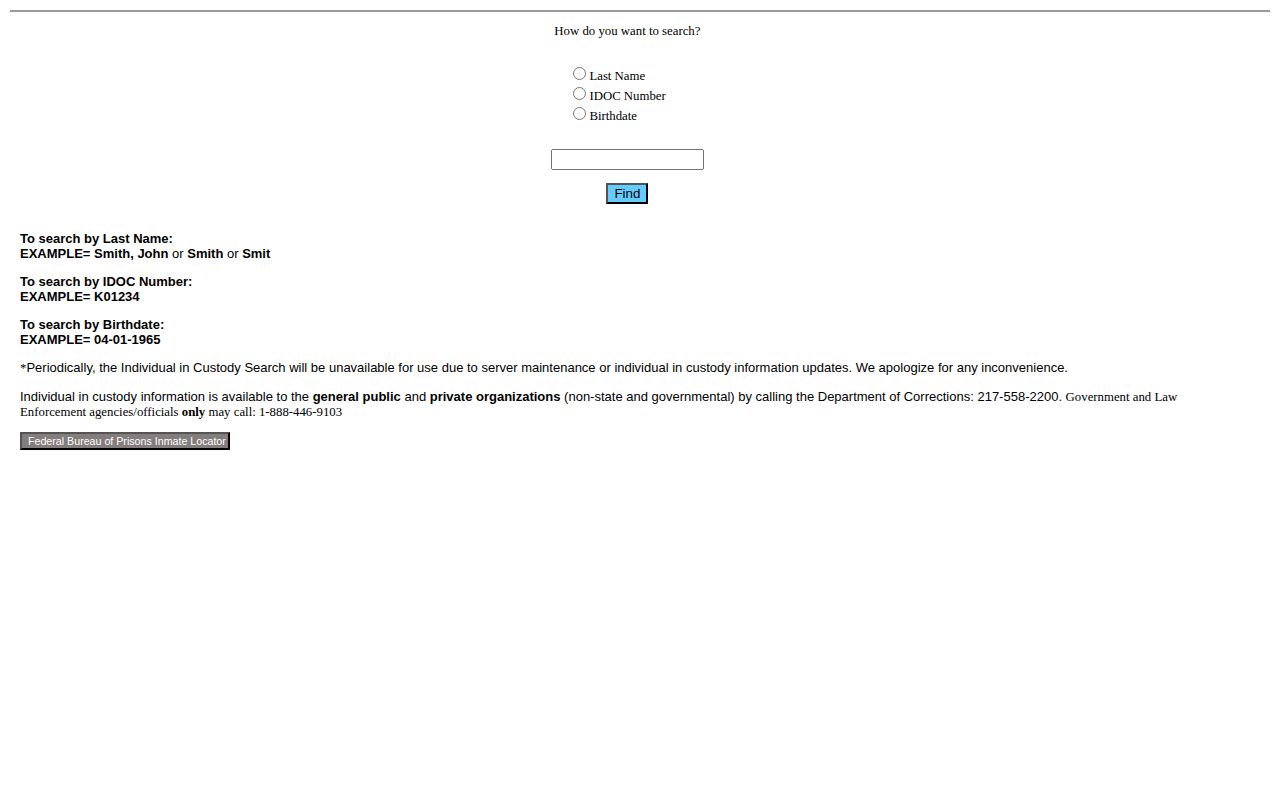
The screen confirms why an IDOC number is preferable when known and why a name-only result must be matched with care.
Livingston Court Records After Release
The Livingston County Circuit Clerk directs public case users to Judici, while the clerk remains custodian of the official file. The docket can preserve charges, hearing dates, minutes, disposition, and sentence after jail information has vanished. This local division of work is useful: Judici explains the case path, and the Sheriff's event record supplies the physical discharge or transfer time.
Visit the Livingston Judici search to compare the official county-specific entry point with the captured page.
Judici uses a CAPTCHA and is a third-party access service. The Livingston County Circuit Clerk is the source for clarification and certified copies.
Livingston Release Notifications and Supervision
Illinois VINE connects with county jail booking systems, IDOC, Illinois DHS, and circuit clerks. Search the correct person and register while an eligible custody record is active. Alerts may cover release, transfer, or escape. Those events are not interchangeable. Telephone registration uses a four-digit PIN to acknowledge a call; email registration does not use that phone PIN. A completed event may not support retroactive registration.
After an Illinois prison release, IDOC's Parole Division supervises parole and MSR, while the Illinois Prisoner Review Board sets conditions and handles violation proceedings. Court probation is separate. Livingston County Probation and Court Services handles local court supervision, and the court docket identifies the order. No statewide public PRB name search for every supervised person was verified. The Post-Release Supervision page separates MSR, old-law parole, probation, and pretrial release.
- MSR
- Mandatory supervised release after an eligible determinate prison term.
- Parole
- Discretionary release used chiefly for qualifying older indeterminate cases and limited statutory categories.
- Probation
- A court-ordered community sentence administered through court services.
- Discharge
- The end point recorded by the controlling custody or supervision system.
Livingston Federal Release Paths
Livingston County Jail houses some federal detainees under agreement. Physical location does not decide legal custody. A USMS prisoner may leave the Pontiac jail for court, another contract jail, or BOP designation without being released. The jail, federal docket, and responsible federal authority form the first path for a pretrial detainee.
The BOP inmate locator covers federal inmates from 1982 forward and is more useful for sentenced people. “Released” or “Not in BOP Custody” does not rule out state custody, immigration custody, or supervision. ICE ODLS separately covers current ICE custody and, according to ICE resources, people released from ICE custody within the prior 60 days. Exact-match rules and coverage limits make an absent result inconclusive.
County Jail or Pontiac Prison?
Pontiac contains both the Livingston County Jail and Pontiac Correctional Center. They are close in place but entirely different in law and records. A person can leave the county jail for the state prison without leaving the city. That is an IDOC transfer, not release to the community.
| Last system | Still in custody | Released or transferred record |
|---|---|---|
| Livingston County Jail | Confirm directly with the jail | Sheriff discharge/transfer entry and Judici |
| Pontiac Correctional Center | IDOC current location | IDOC actual release/status and FOIA |
| Federal detainee at county jail | Housing jail, docket, or federal custodian | Federal docket, USMS authority, then BOP if covered |
| ICE custody | ICE ODLS | ODLS within its limited released-person window or ICE inquiry |
Livingston Jail Traffic and Transfers
Local jail statistics show why physical departure must be classified before it is called release. The June 2024 IDOC inspection describes a rated capacity of 179 and an inspection-day count of 158. Those are dated facility figures, not a present roster. They cannot show whether any named person remained in custody or left on a given day.
A February 2025 Sheriff, Jail and License Committee report adds the custody mix. It listed an average out-of-county population of 83, including federal and other-county detainees, compared with an average Livingston County population of 59. The same report counted 80 bookings and 64 transports during its reporting period. Five people were transferred to IDOC across three trips, while other transports involved federal court, medical care, Livingston court, or another county. These aggregate figures demonstrate movement through the building, but none is an individual release record.
Work-release participants and “weekenders” create another status trap. A person may be outside the secure building under an authorized schedule without completing the sentence or receiving final discharge. Only the governing order, current jail status, and final event entry settle that question. Likewise, a booked-and-released person remains a booking in monthly statistics. A late-night booking followed by an early morning bond release may span two counted jail days, so totals and averages cannot reconstruct an exact door time.
The federal contract layer is especially significant. A person housed in the county building may be controlled by the U.S. Marshals Service and later moved for trial, sentencing, medical care, or BOP designation. County staff may accurately say “transferred” even when a general federal locator has not yet caught up. In that gap, use the federal docket, the housing jail, and the responsible federal authority. Do not turn missing county data into a claim of community release.
After a Livingston Jail Discharge
The 2024 inspection checklist identifies release safeguards that can help document a completed discharge. Audited items include returning inventoried personal property, recording maintenance medication released with the person, retaining a signed itemized property receipt, and handling transfers to IDOC according to law. Because checkbox extraction can lose visual meaning, those points are best described as matters IDOC audited, not as unsupported claims about the answer to every checklist item.
A focused request may seek a releasable signed property receipt tied to the booking and discharge. That is different from asking for a confidential medical file. Seized investigative property follows another process and may remain held until the State's Attorney awards it to the Sheriff or back to the defendant. The return of ordinary clothing or a wallet during discharge does not prove that seized evidence was also returned.
No official source verified a fixed daily release hour, public exit door, family waiting area, or weekend schedule. Call the jail for current instructions. SHOW BUS publishes Livingston and Pontiac transportation information, but no source promises a jail-door stop or transport for released detainees. Confirm routes, reservations, stops, and service directly before relying on them.
Did Pontiac Release Everyone?
No. The official Pontiac Medium Security Unit page reported a population of zero as of June 30, 2024. That dated facility statistic is not a list of Livingston County released inmates, proof of current closure, or evidence about any named person. Person-level release must come from an IDOC profile or record.
Dwight Correctional Center presents a different trap. It closed in 2013 and is a historical facility, not a present search destination. Former incarceration and release records connected with Dwight remain an IDOC records matter.
Livingston County Release Facilities
Choose the page that matches the last known custodian. Each path explains where a person may go and which record can confirm the event.